Automated Security Door System
Course: ME 351 – Introduction to Measurement Systems
Team: Walker Waggoner, Ahmed Moussaoui
Demo
Problem
As delivery robots like Starship become common on campus, the question arises: how do you design a door that only lets people through — not robots? This project set out to build a miniature automated double-door system that screens who (or what) can enter based on physical characteristics of life.
The system needed to:
- Detect motion and proximity to trigger the door
- Screen for metal to identify and block robotic systems
- Never close on someone passing through
- Handle forced entry attempts and jams safely
What I Did
3D Printing & Assembly
Modified the baseline Fusion 360 CAD to improve assembly practicality, then printed the full door structure on my Creality Sermoon D1 (~750g of filament). Spent ~4 hours on CAD modifications and another ~4 hours wiring and assembling the test article — integrating the Arduino, breadboard, servo, and all sensors into the enclosure.
Handmade Metal Detector
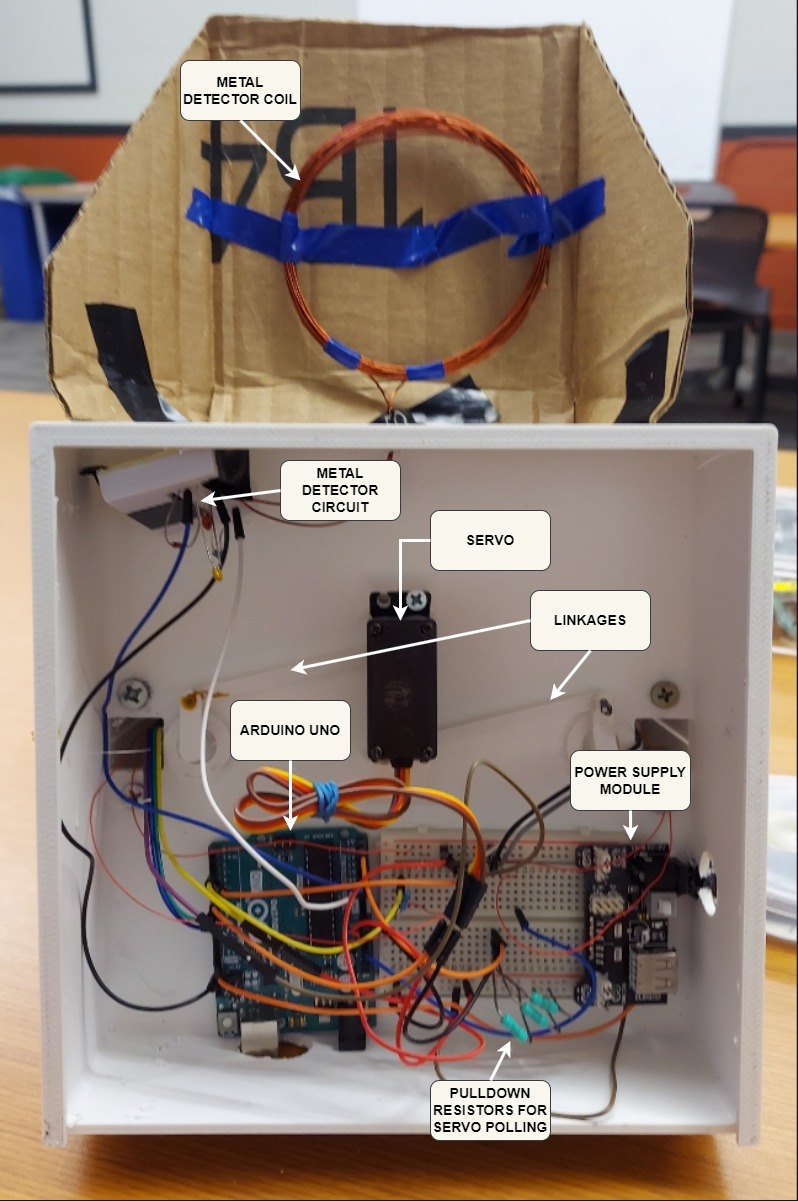
Designed and built the metal detection circuit from scratch using materials I had on hand. The detector works by:
- Pulsing a hand-wound copper coil to charge a capacitor
- Measuring the capacitor voltage as the coil’s field collapses
- Detecting the drop in voltage that occurs when metal changes the coil’s inductance
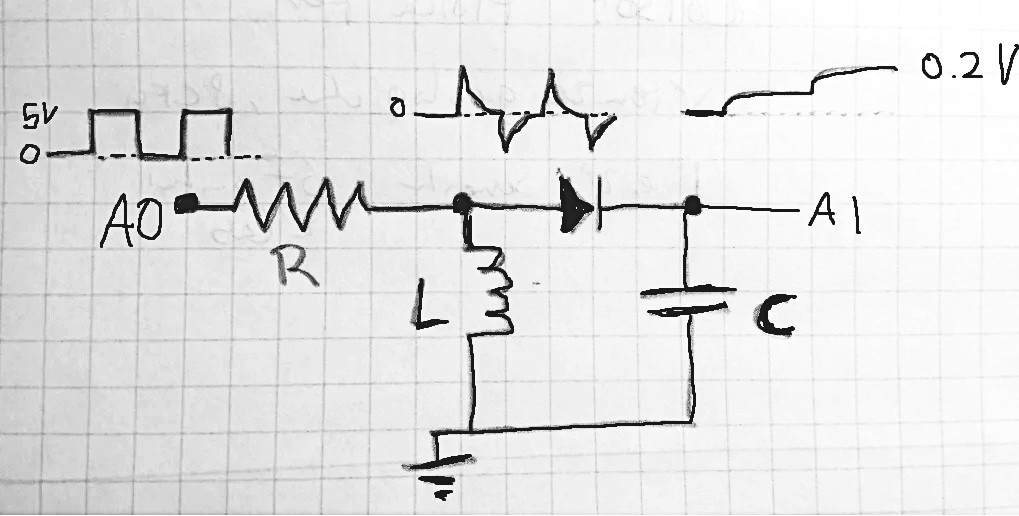
To eliminate noise, I averaged 256 readings per cycle. The baseline reading with no metal was ~0.20V — metal near the coil consistently dropped it below the threshold. No off-the-shelf module: just an inductor, capacitor, diode, and resistor.
State Machine & Software
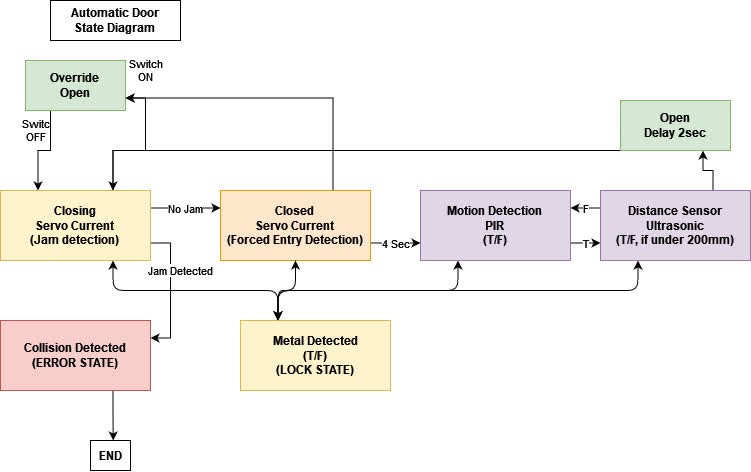
Wrote and debugged the bulk of the control code — a state machine with 5 states:
| State | Behavior |
|---|---|
| Closing (A) | Servo drives to closed; polls current for jam detection |
| Jammed (B) | Error state — opens door, sounds alarm, halts |
| Closed (C) | Idles; monitors PIR for motion; alarms on forced push |
| Distance Check (D) | Ultrasonic reads proximity; opens door if object < 300mm |
| Metal Lock (E) | Alarm sounds; door stays closed until metal clears |
Key software features:
- Jam detection via servo current polling — if current draw spikes above threshold while closing, the door opens and alarms instead of crushing whatever is stuck
- Forced entry detection — if someone pushes on the closed door, a separate alarm fires and the servo actively pushes back to closed position
- PIR interrupt — motion wakes the system from idle without polling
- Toggle switch interrupt — manual override that holds the door open regardless of state
- Metal filtering — 256-sample averaged analog read to cleanly distinguish metal presence from noise
Debugging Wins
- Servo voltage issue: the Sunfounder 55g servo has a narrow 4.8–6V range. A single pull-down resistor dropped voltage too far, causing the servo to spin continuously. Fixed by using two 10Ω resistors in parallel (5Ω total) to keep the supply in range.
- Ultrasonic wiring: echo and trigger pins were swapped, causing no serial output — caught with a multimeter continuity check.
Results
A fully autonomous double-door system that:
- Opens only for non-metallic objects within 300mm
- Actively blocks and alarms on metal detection
- Recovers safely from jams and forced entry
- Supports full manual override via toggle switch
System Design
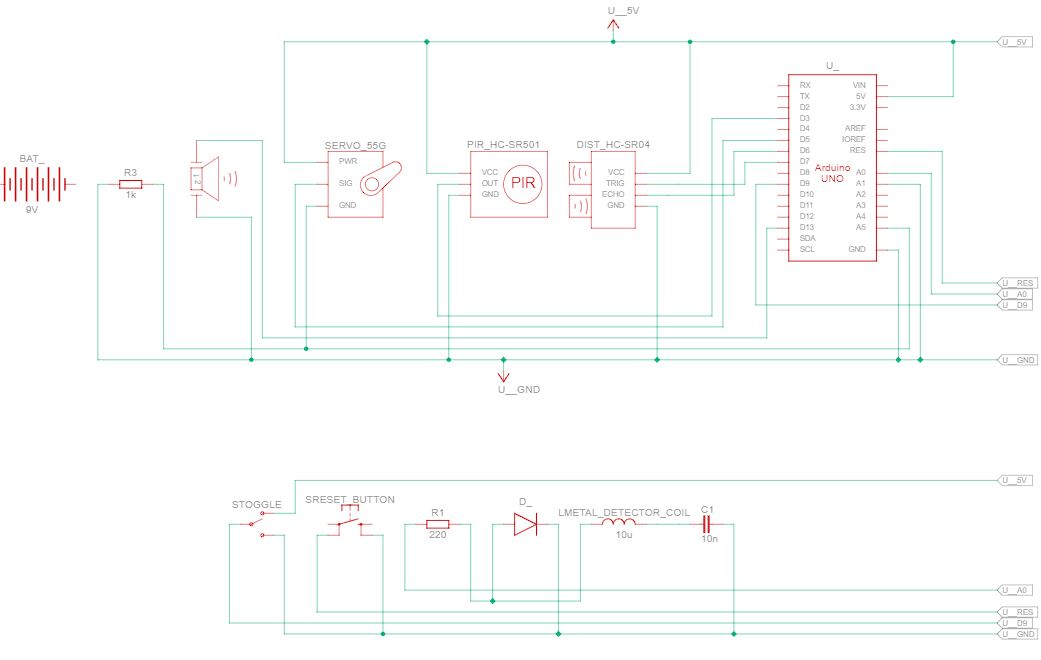
System schematic:
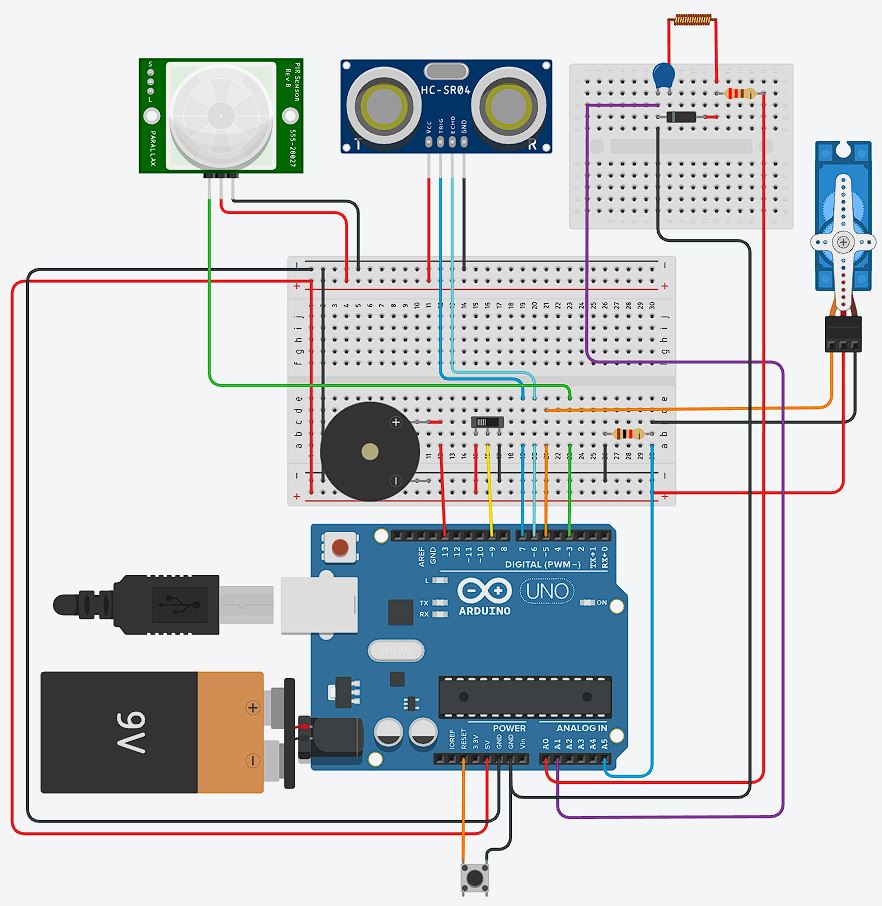
TinkerCad wiring diagram:
State diagram:
Build
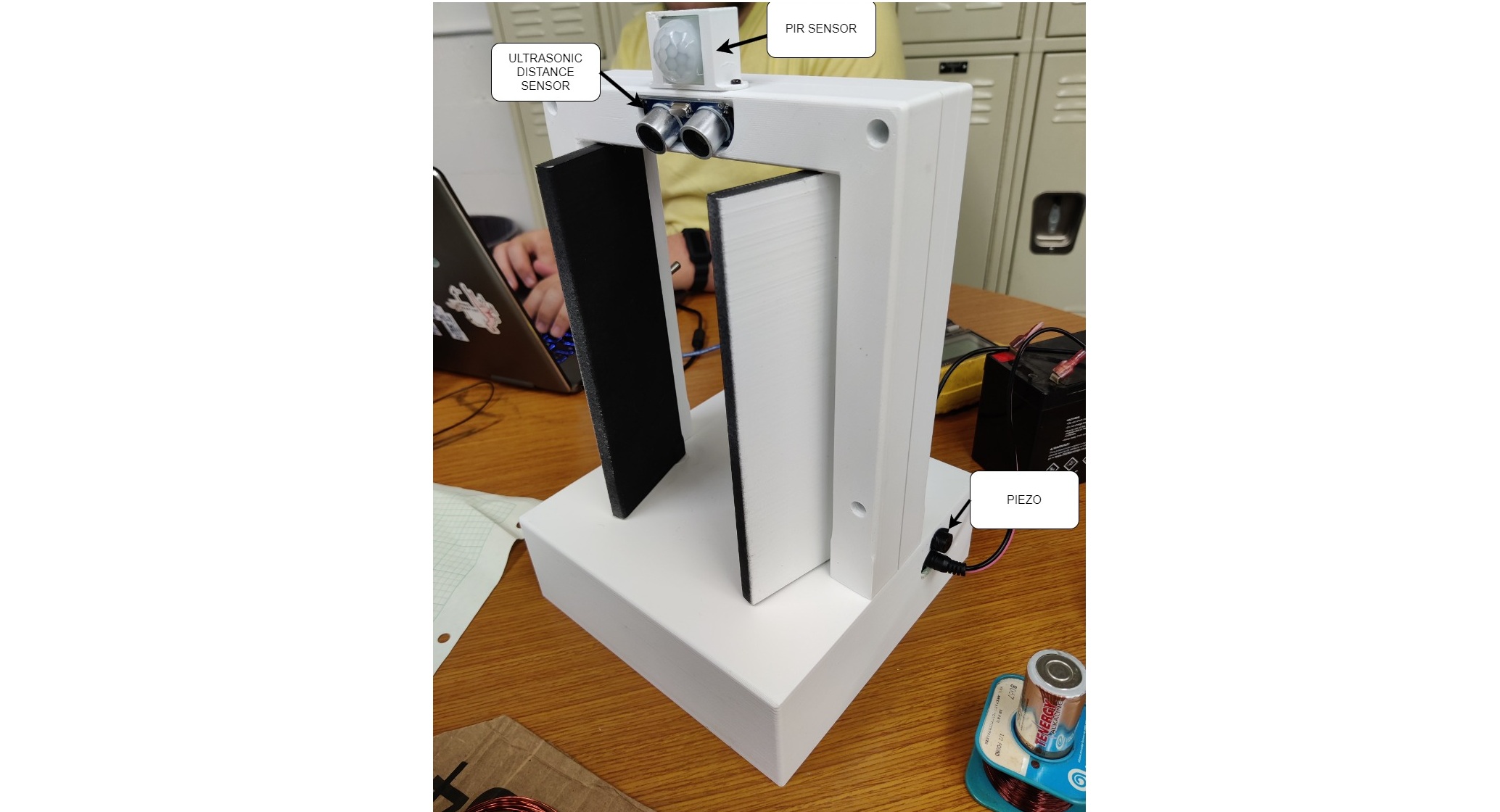
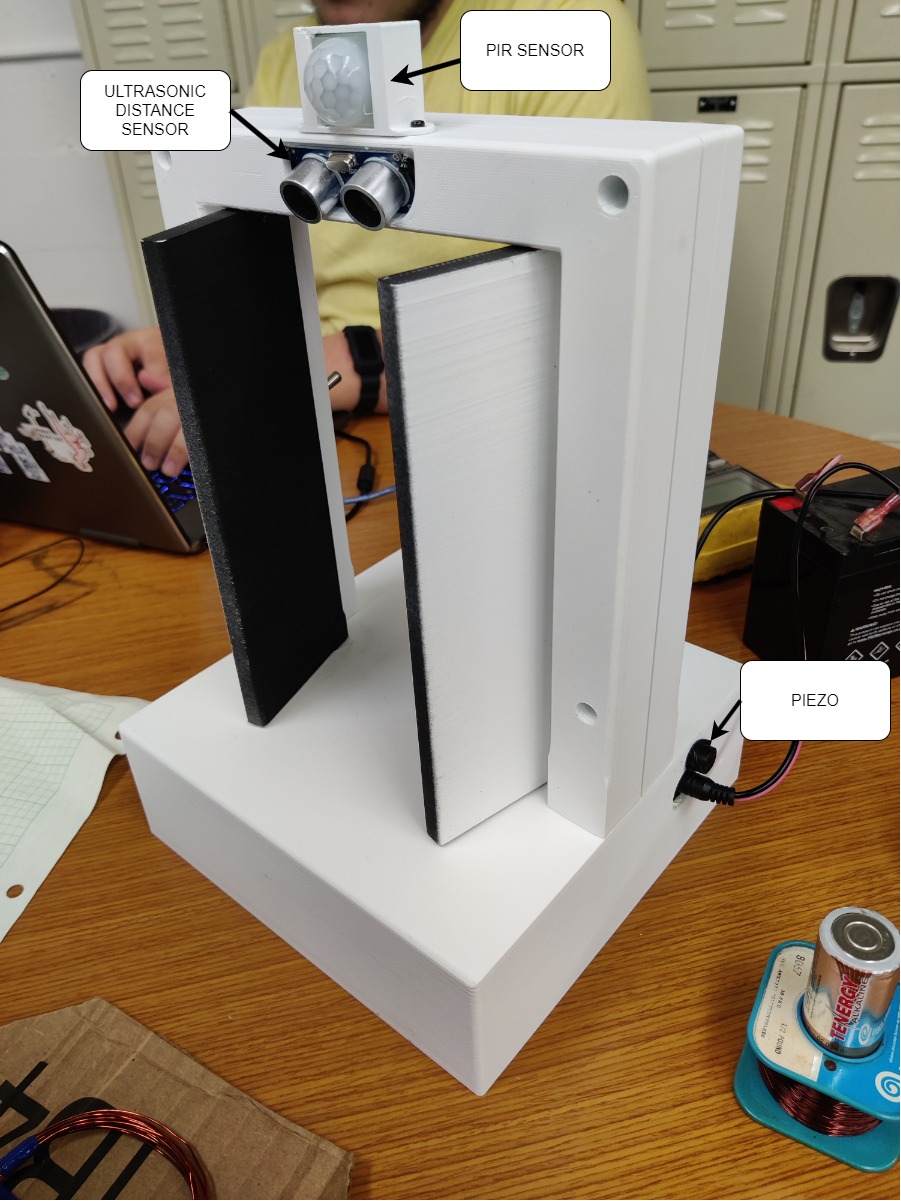
Front — PIR sensor and ultrasonic distance sensor mounted above the door frame:
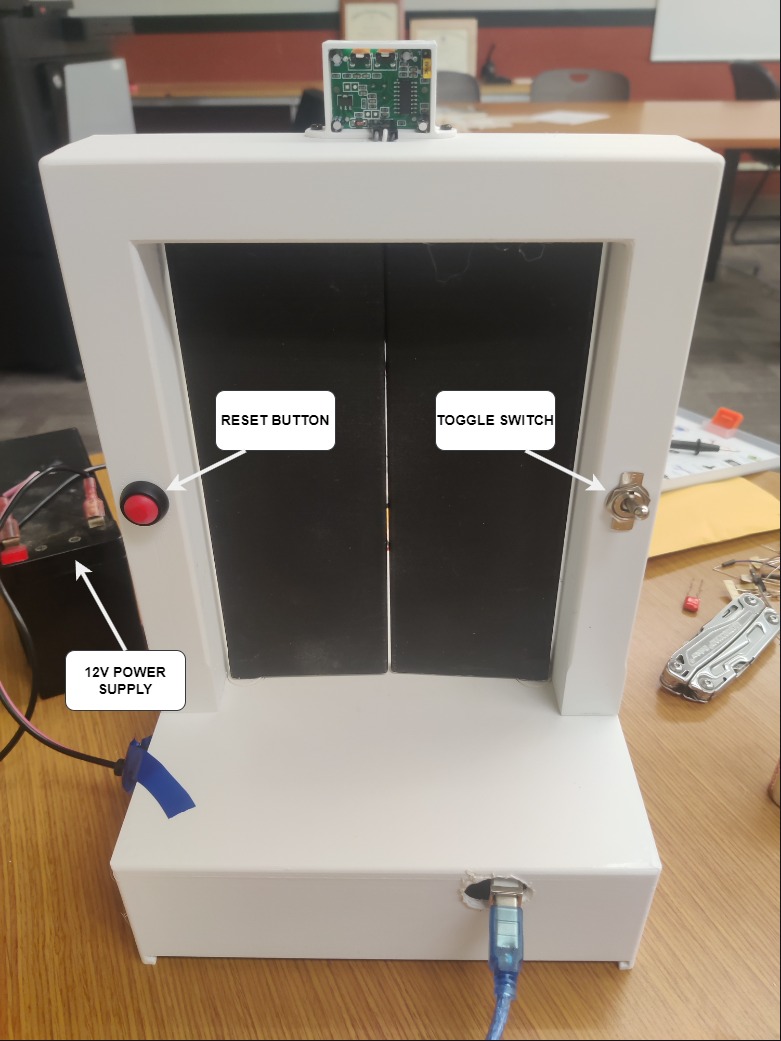
Back — reset button, toggle switch, and 12V power supply:
Underside — Arduino UNO, servo, linkages, metal detector circuit, and breadboard: